

Best Air Tents NZ | Zempire vs Kiwi Camping
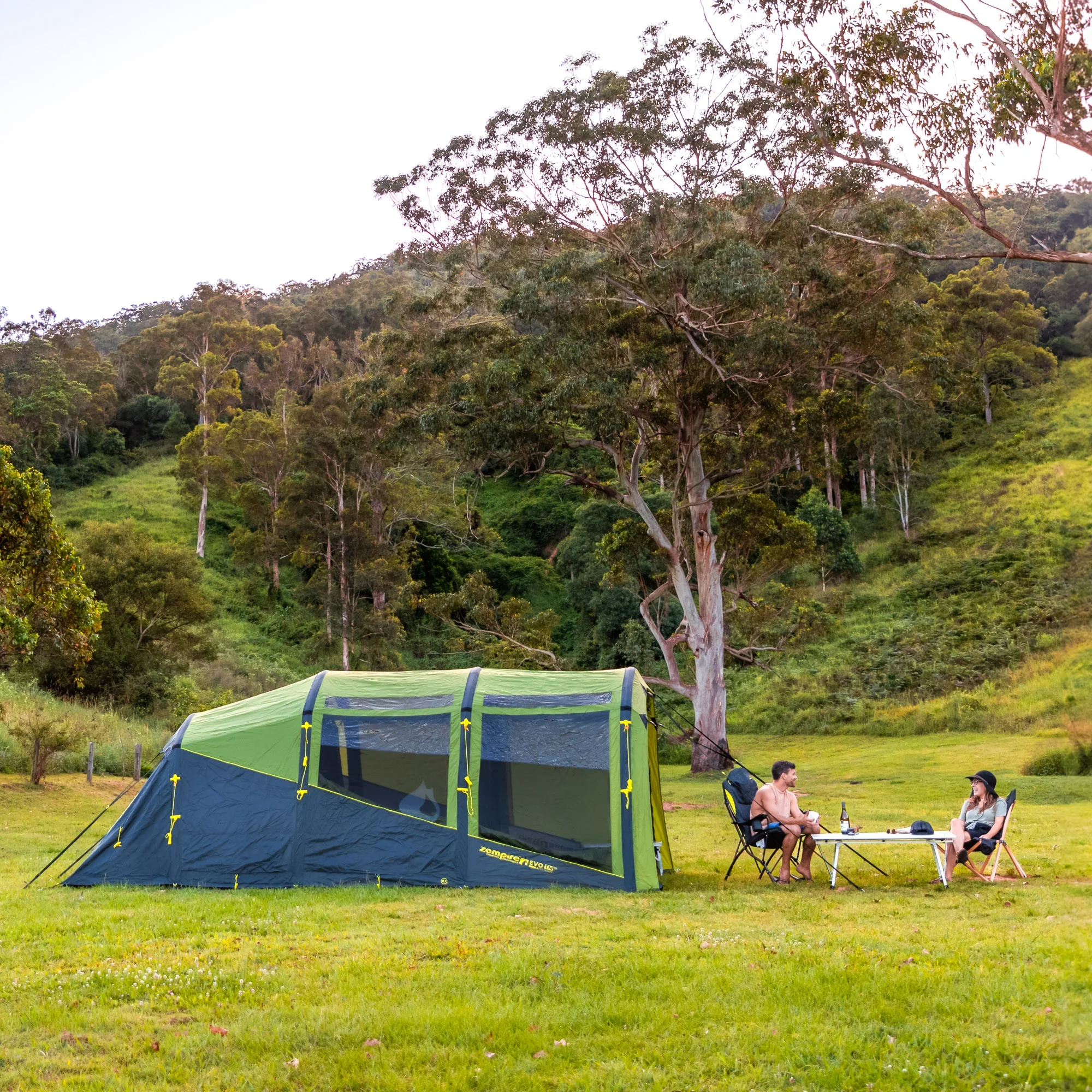
The Complete Guide to Air Tents in NZ: Zempire vs Kiwi Camping
In 2026, we have progressed a fair way from pulling out our grandfather's canvas pole tent that he carefully tucked away in the back corner of the garage, only to be aired out each September. It is a nostalgic memory for plenty of us who grew up camping through the 80s and 90s. Times have changed, there is no doubt about it, and naturally tent technology has evolved with them.
The core concept of a good tent has not changed that much. It still needs to keep the family dry, stand up when the weather turns, give everyone enough room to live comfortably and, ideally, not create an argument before the first beer has been opened. What has changed is how easily we can now get to that point.
As we curate our tent ranges each year, the family tent category keeps shifting further towards air. We are seeing more customers ask about air tents, more families move away from poles and, importantly, more confidence in the technology itself. For a long time this category was dominated by Zempire. That is still the benchmark brand in my eyes, but the recent development coming out of Kiwi Camping has made the conversation a lot more interesting.
So, rather than writing another generic list of the best family tents in NZ, we wanted to go properly into the detail. This guide is primarily about Zempire Air Tents vs Kiwi Camping Air Tents, while also giving you the context to understand the wider inflatable tent market, the different ranges, and whether an air tent is actually the right choice for the way your family camps.
For years, Zempire have dominated the air tent or inflatable tent market here in New Zealand and, if we use range depth and market presence as the primary metrics, they still do. It has taken years to transition camping purists away from their trusty pole tents and, given the memories people attach to camping gear, I think that is only fair. The same questions have followed air tents around for years: What happens if it pops? How strong are these things in the wind? Can an inflatable tent genuinely stand up to NZ conditions?
Zempire have done a huge amount of the heavy lifting in answering those questions. Their air-frame technology now stretches from genuinely portable sub-$1,000 tents right through to enormous premium canvas family setups. The point is not that every air tent is automatically better than every pole tent. The point is that air is no longer a novelty. It is now a mature category and, for plenty of families, arguably the most convenient way to camp if the budget allows.
What makes this guide particularly relevant now is what is happening over at Kiwi Camping. The ground-up development of the Tui Air range got our attention immediately. It is clear Kiwi Camping did not simply want to copy what was already in the market. The built-in battery-powered auto-inflation system on the Tui is the obvious example, but the bigger point is that Kiwi are now building a genuine air-tent ecosystem of their own. With the new Swift 4 and Swift 6 joining the range for Spring 2026, there is finally proper competition at both the premium family end and the more accessible end of the market.
Zempire vs Kiwi Camping Air Tents: The Quick Comparison
Straight away, the comparison tells us two things. First, Zempire still has the deeper air-tent ecosystem by a fair margin. Second, Kiwi Camping are no longer just dabbling in the category. Between the Tui and Swift ranges they now have a clear proposition at two very different price points, and that matters for anyone buying an inflatable tent in NZ this season.
| What matters | Zempire Air Tents | Kiwi Camping Air Tents |
|---|---|---|
| Current air-tent families | Aerospeed, Evo, Pro, Shapeshifter and Air Canvas | Tui and Swift |
| General position | The broadest air-tent ecosystem in the NZ market, from portable entry models to premium canvas family tents | A tighter range focused on value, convenience and a distinctly Kiwi approach |
| Indicative price span | $800 to $7,000 across current NZ air-tent ranges | $699 to $2,999 across Swift and Tui based on 2026 pricing |
| Entry point | Aerospeed 4 at $800 | Swift 4 at $699 |
| Premium family range | Pro, Shapeshifter and Air Canvas | Tui 4, Tui 6 and Tui 8 |
| Inflation approach | Varies by range. Single-point or multi-point inflation depending on model; compatible with manual or suitable electric pumps | Tui uses built-in battery-powered auto inflation with a manual pump backup. Swift is positioned as the simpler, more affordable air option |
| Family sizes | Very broad. Compact couples/weekend options through to huge multi-room family setups | Tui covers 4, 6 and 8-person family camping; Swift covers 4 and 6-person entry-level air camping |
| Fabric options | Polyester/synthetic ranges plus premium polycotton Air Canvas | Polyester air tents in the current Tui and Swift ranges |
| Waterproofing | Varies by range; Pro and premium ranges sit at the higher-spec end | Tui uses an 8,000 mm double-coated 150D polyester fly |
| Packability | Aerospeed is the standout if weight and vehicle space are priorities; premium ranges become substantially heavier | Tui is a big family tent and packs accordingly; Swift is the more compact proposition |
| Modularity | Excellent. Links, shelters, awning walls, heat shields, liners, footprints and the fully modular Shapeshifter system | Tui has a growing ecosystem including pod rooms, blackout flies, front walls, groundsheets and Savanna shelter connectors |
| Warranty | Range dependent: Aerospeed 2 years, Evo 3 years, Pro 4 years; other series vary | Tui is backed by a 3-year warranty |
| Biggest strength | Range depth, refinement, design, proven air-tent experience and an ecosystem that can grow with you | Convenience and value. Tui's built-in auto inflation is a legitimate point of difference |
| Main consideration | You can spend serious money once you move into Pro, Shapeshifter or Air Canvas | The ecosystem is newer and nowhere near as deep yet; Swift is also too new for the same long-term track record |
| Best suited to | Campers who want to buy into a mature system and choose precisely how far up the comfort/performance ladder they want to go | Families who want straightforward air-tent convenience, strong spec for the money and a fresh alternative to the established leader |
Specifically speaking to the Kiwi Camping Tui range for a minute, what caught our eye when ranging the Tuis was the built-in battery-powered inflation system. It sounds like a small thing until you picture the reality of arriving at camp with kids, gear everywhere and daylight disappearing. Roll the tent out, peg the main points, connect the battery-powered inflation system and let the frame do the hard work. There is still a manual hand pump in the bag as backup, which is exactly how it should be.
Convenience aside, the Tui range hits the key aspects we expect from a serious family air tent in 2026. The 150D polyester fly carries an 8,000 mm waterproof rating and UPF50+ protection, the bedrooms are darkened and configurable, the doors and mesh are well thought out, and the accessory range is already much broader than it was when Kiwi first entered this space.
Price is where the head-to-head gets particularly interesting. The Tui 4 sits at $1,999, the Tui 6 at $2,499 and the Tui 8 at $2,999. That puts them directly into the part of the market occupied by established Zempire Evo and Pro models. You are no longer comparing a budget air tent with a premium product. You are comparing two legitimate family systems with different strengths.
Before we get into the full Zempire ecosystem, it is also worth touching on the new Kiwi Camping Swift range landing for Spring 2026. We all know the success of the Zempire Aerospeed range, which made air-tent technology far more accessible without turning the tent into a 40 kg monster. The incoming Swift 4 and Swift 6 are priced at $699 and $899 respectively, putting a very deliberate target on Aerospeed territory.
That creates an interesting question: is Zempire still the leader in the air-tent market? In my opinion, yes. Call me a sucker for the finer things in life, but when the better Zempire ranges are standing beside most competitors, the design flare, finish and depth of thought are still obvious. That does not mean Zempire should trump every purchase. It simply means they have had longer to refine the category.
Kiwi Camping are clearly building their own lane. The Tui system already allows families to add pod rooms, blackout flies, front walls, groundsheets and connectors into the Savanna shelter ecosystem. Zempire built an incredibly loyal community not just around good tents, but around the idea that your campsite can evolve over time. Kiwi are now heading in a similar direction. Once you start buying the links, walls, shelters and accessories, it pays to think beyond the tent you are buying today.
Zempire Air Tents Explained
Speaking of ecosystems, nothing in the NZ market currently comes close to the breadth of Zempire's air-tent offering. The important thing is that the ranges are not just different sizes of the same tent. Each series has a pretty clear job, and understanding that job makes choosing between them much easier.
Zempire Aerospeed Air Tents
If you want the benefits of an air tent without giving half the boot to your tent bag, Aerospeed is where I would start. This is Zempire's genuinely portable air range and, to me, that is the whole point of it. The Aerospeed 4 weighs under 10 kg, the range uses a compact single-point air frame, and the tents still give you proper standing headroom rather than feeling like a hiking tent that has been blown up.
The Aerospeed 4, 6 and 10 cover couples, smaller families and larger crews without losing the portable philosophy. Zempire's Dura-Core fly fabric is designed to be durable and fade resistant, the frame inflates fast and there are multiple deflation points to make pack-down less painful. You can also connect into the Speedbase shelter ecosystem when you want more covered living space.
Who is it for? Families who move around, campers with smaller vehicles, people doing shorter trips and anyone who has looked at a traditional family air tent and thought, 'there is no chance I am lifting that into the roof box.' Aerospeed is the range that proves an inflatable tent does not have to be huge, heavy or expensive.
Zempire Evo Air Tents
Evo is the sweet spot in the Zempire range and probably the easiest series to recommend to the widest group of campers. It gives you a noticeable step up in family-tent comfort and weather capability without immediately jumping into Pro-level pricing.
The range runs from compact touring options such as the Evo TS through to larger TM, TL and TXL family layouts. The angled air-beam construction improves headroom and rigidity, the tents have proper full-height living space, and the accessory ecosystem is well established with awning wall sets, shelter links and heat-management options depending on model.
This is the range for the family that camps often enough to care about setup speed and comfort, but does not necessarily need every premium feature available. It is also where Zempire's air-tent experience becomes really obvious. Nothing feels experimental. The layouts, ventilation, doors and connection points have all been refined over multiple generations.
Zempire Pro Air Tents
Pro is where Zempire starts throwing the kitchen sink at it. If Evo is the all-rounder, Pro is the range for people who want the extra features, heavier-duty specification and a more premium family-camping experience.
The current Pro models use a fully inflatable frame with single-point inflation on key models, an 8,000 mm waterhead on the Pro TM V2, darkened multi-room sleeping areas, generous head-height living zones, large ventilation systems and tinted skylights that make the inside feel noticeably more open. On the Pro TM, for example, the whole air frame and awning can be inflated from a single point in around two minutes.
This range starts making sense when camping is part of your family lifestyle rather than something you do once every second summer. You pay more and you carry more, but in return you get a tent that feels properly considered for longer stays, mixed weather and repeated use. For many families, this is the point where a tent starts feeling more like a portable holiday home.
Zempire Shapeshifter Air Tents
Shapeshifter is the most interesting product Zempire have launched in years because it changes the question from 'what size tent should I buy?' to 'what tent do I want to build for this trip?'
The system is genuinely modular. You start with Sleeping, Living and Awning modules, then zip them together in different combinations. A family might run a smaller Sleeping + Awning setup for a quick weekend, add the Living module for the longer summer trip, or build out an enormous configuration when more people are coming. The 4-person and 6-person systems can be configured in multiple ways and the bigger setups can become seriously substantial campsites.
The fabric is Zempire's 170D Aeroweave synthetic canvas and the oversized air tubes are built with wind stability in mind. The near-vertical walls make the space feel usable rather than simply impressive on a floor plan. It is not the cheapest or simplest way into an air tent, but that is not what it is trying to be. Shapeshifter is for experienced campers who know their needs change from trip to trip and are prepared to buy into a system that can change with them.
Zempire Air Canvas Tents
At the top of the Zempire tree sits Air Canvas. If Aerospeed is about portability, Air Canvas is basically the opposite philosophy: maximum comfort, durability, climate control and long-term family camping.
The Airforce 1 V2, Fortress V2 and Delta Force V2 use breathable polycotton canvas with oversized inflatable frames. The V2 generation is fully inflatable, including the awnings, and uses single-point inflation so a tent of this physical size is remarkably simple to get standing. The Airforce 1 V2, for example, is a true 10-person family setup with configurable rooms and a fully inflatable frame, while the larger models push further into long-stay holiday-camp territory.
These are not small tents and they are not cheap. You need vehicle space, a decent campsite and the budget to justify them. But if your family does the classic Kiwi summer holiday where the tent is home for a couple of weeks, breathable canvas is hard to beat. It feels better in the heat, deals beautifully with changing temperatures and, looked after properly, is built for years of use.
It is clear Zempire has almost every version of family air camping covered, but range depth is not the only reason the brand continues to stand out for me. We are lucky enough to work with some of the most inspiring outdoor and lifestyle brands in the world. In conversations about design flare, craftsmanship and brands that understand how a product should make the customer feel, names like Snow Peak, Land Rover, YETI and Norda come up. Zempire belongs in that conversation. The best products do the functional stuff brilliantly, then give you that extra moment when you walk back towards camp and think: that is a great-looking setup.
Kiwi Camping Air Tents Explained
Kiwi Camping's air-tent offering is much simpler to understand. For the 2026 season there are two families that matter: Tui and Swift. That is it. The rest of Kiwi Camping's tent range may be relevant to family camping, but it is not part of this air-tent comparison.
Kiwi Camping Tui 4 Air Tent
The Tui 4 is the entry point into Kiwi's premium auto-inflating family range and, for a family of three or four, it is probably the most natural place to start. It sleeps four maximum, has a one-to-two bedroom layout and enough internal height and living space to feel like a proper family tent rather than an oversized weekender.
The headline feature is the built-in auto-inflate system powered by two lithium-ion batteries. It is not just a gimmick. When you are setting up a 34 kg family tent, having the frame do the inflation work while you sort pegs, kids and the rest of camp is genuinely useful. You still get a manual pump in the bag, which means you are not relying on electronics to have a holiday.
The 150D fly carries an 8,000 mm waterproof rating and UPF50+ protection, the bedrooms are darkened, and the tent uses a full-width front opening plus large mesh and side doors to keep airflow moving. Add the accessory options and it becomes a very compelling alternative to the established Zempire mid-range.
Kiwi Camping Tui 6 Air Tent
The Tui 6 is probably the volume family model in the range. It steps up to a six-person maximum with a comfort rating of four to five and, importantly, gives you the floor space for a proper family setup without going to the sheer footprint of the Tui 8.
The rear sleeping area can be run as one large room or split into two, and an optional pod room can add another bedroom. The living area is generous enough to actually use when the weather turns, while the porch and vestibule give you somewhere to dump the wet gear that otherwise ends up living beside everyone's beds.
At $2,499 it sits right in the middle of serious family air-tent territory. That means the comparison is not simply price. You should be looking at the Tui's auto-inflation and accessory ecosystem against the refinement, layout and long-established range depth of the equivalent Zempire options.
Kiwi Camping Tui 8 Air Tent
The Tui 8 is the big one. This is for larger families, families who want more separation between sleeping spaces, or people who simply refuse to spend two weeks at the beach living on top of one another.
It can be configured with up to three bedrooms in the rear, with further flexibility from the optional pod room. The big living area, 2.25 m peak height and multiple sheltered zones make it a genuine long-stay family tent. Like the rest of the Tui range, it gets the 150D fly, 8,000 mm waterproofing, darkened bedrooms and battery-powered inflation system.
At $2,999 it is not an impulse purchase, but considering the amount of tent you are getting, the pricing is aggressive. For families comparing this with a larger Evo, a Pro or even entry Shapeshifter configurations, it deserves to be on the shortlist.
Kiwi Camping Swift 4 Air Tent
The Swift 4 is the product I am particularly interested to see in the market this Spring because it attacks a very different part of the category. At $699, it brings Kiwi Camping below the current Aerospeed 4 price and gives customers another way into air-tent technology without making a $2,000 decision.
Because the Swift range is new for Spring 2026, I would be careful about pretending we have years of customer feedback behind it. We do not. The appeal is straightforward: four-person air-tent convenience at a genuinely accessible price. If the production version delivers the balance of pack size, pitching ease and build quality we expect, it could become a very important range for Kiwi Camping.
Kiwi Camping Swift 6 Air Tent
The Swift 6 follows the same logic but gives families more room for $899. Again, the target is obvious. This is the part of the market where Aerospeed has shown there is strong demand for air tents that are lighter, simpler and far easier on the wallet than the traditional premium family-air setup.
For a family wanting air primarily because they hate poles and want a quicker pitch, rather than because they want a giant multi-room campsite, Swift could make a lot of sense. We will know much more once the range has been through a full NZ summer and customers have put serious mileage on it. For now, the pricing alone makes it one to watch.
The important point is that Kiwi Camping's 2026 air range now makes sense as a system. Swift gives them an accessible entry point. Tui gives them a premium, feature-rich family platform. The question from here is how far they take it. Do we eventually see a Kiwi rival to Zempire Pro? Do they return to air canvas? Do they create something as modular as Shapeshifter? Time will tell, but competition in this category is a good thing for every Kiwi camper.
Why Choose an Air Tent Over a Pole Tent?
As I mentioned at the start of this buying guide, the goalposts have shifted considerably in the last 20 years. Every season I talk to Land & Sea customers who say they will never go back to poles after buying their first air tent. I also meet plenty of experienced campers who still love a good pole tent, and there are valid reasons for that too.
Air is not automatically the answer for everyone. It costs more, it can weigh more and, depending on the tent, the packed bag can be substantial. Pole tents will always have a place. The useful comparison is not 'new technology good, old technology bad'. It is understanding what changes in the real world when you swap rigid poles for an inflatable frame.
| Consideration | Air Tent | Pole Tent | What it means in the real world |
|---|---|---|---|
| Setup speed | Once laid out and pegged at the main points, the frame is inflated rather than assembled pole by pole. Many models are genuinely very fast and some can be inflated from a single point. | You need to identify, assemble and feed or clip multiple poles into the tent. On a well-designed tent this is fine, but larger family models take longer and usually need more hands. | If arriving late, setting up solo or camping with young kids, air has a clear convenience advantage. |
| Ease of pitching | The process is repetitive and simple: lay out, peg, inflate, trim and guy out. There is less working out which pole goes where. | More physical assembly and more opportunity to put the wrong pole in the wrong sleeve, especially if you have not used the tent for a year. | Air is generally easier for one person and easier to remember between trips. |
| Wind behaviour | Air tubes can flex under wind load rather than snapping. Good air tents use large-diameter tubes, aerodynamic shapes and proper guying to create a very stable structure. | Quality pole tents can be extremely strong, particularly with aluminium frames, but rigid poles can bend or snap if overloaded. | Neither system is magic. Correct site choice, pegging and guying still matter. Air removes the classic snapped-pole failure mode. |
| Failure mode / reliability | The fear is a puncture or valve issue. In reality, air tubes sit inside protective sleeves and are repairable or replaceable. Multi-tube and isolation systems can also limit a problem to one section. | Poles are mechanically simple and easy to understand, but can split, crack or snap. Replacement poles or sections may be required. | Both can fail. Air failures are different, not necessarily more common. Carry the supplied repair kit and know how your valves work. |
| Weight | This varies massively. Portable ranges such as Aerospeed can be very light, but big Tui, Pro and Air Canvas tents can be heavy because there is simply a lot of fabric and floor area. | A comparable pole tent can often be lighter, particularly when using aluminium poles and simpler fabrics. | Do not assume 'air' means light. Compare the actual packed weight of the models you are considering. |
| Packed size | The air frame folds down with the tent, which removes long pole bags. Compact air tents can pack brilliantly, while large family models are still bulky. | Pole sections dictate one dimension of the packed bag, but the overall package can be smaller on simpler tents. | For hatchbacks and roof-box users, look at packed dimensions, not just litres or marketing claims. |
| Price | Air frames, valves and the extra engineering cost more. The best family air tents sit at a premium. | Pole tents cover everything from entry-level family camping to premium technical shelters and generally give you more low-cost choices. | If budget is the main constraint, pole tents still win. If setup convenience is worth paying for, air starts to justify itself. |
| Living space | Air beams allow wide, high structures with near-vertical walls and proper standing room. Premium ranges can create huge living zones. | Pole tents can achieve the same thing, but large structures often require more poles, cross-bracing and setup time. | This is one reason air has become so strong in family camping rather than just small weekend tents. |
| Pack-down | Open the valves and the structure collapses quickly. Multiple deflation points can make a big tent surprisingly easy to flatten and roll. | Every pole needs to be unclipped or removed, broken down and bagged before the tent can be fully packed. | Air generally wins for speed, although getting all the air out of a large tent still requires a decent roll. |
| Longevity | A quality air tent can last for years if it is dried properly, stored well and protected from unnecessary abrasion. Tubes and valves are serviceable components. | A well-made pole tent can also last for many years and has fewer inflatable components to maintain. | Fabric care matters more than most people realise. UV, salt, mildew and packing a wet tent will age either system quickly. |
| Repairability | Small tube punctures can often be repaired, and inner tubes can be replaced without throwing away the tent. Valves are serviceable on quality systems. | A broken pole can often be sleeved temporarily and replacement sections are usually straightforward. | Both systems are field-repairable if you carry the right kit. Learn the fix before the holiday, not during a storm. |
| Best use case | Family car camping, touring, people pitching solo, frequent campers and anyone who values fast, low-stress setup. | Budget-conscious camping, occasional use, lightweight/simple setups and campers who prefer traditional mechanical simplicity. | Choose based on the way you actually camp, not the technology you think you are supposed to want. |
The biggest practical win for air is not that it reinvents camping. It removes one of the most annoying parts of it. A large family tent can go from being a construction project to something one adult can realistically manage while the other sorts the kids, beds and food.
The biggest argument for poles is still price and simplicity. If you camp twice a year, have no issue pitching a pole tent and would rather put another $1,000 into mattresses, chairs and a better chilly bin, that is a perfectly sensible decision. Air tents make the most sense when the convenience is something you will repeatedly benefit from.
So, Zempire or Kiwi Camping?
What we have established is that we now have one fast-growing category but two quite distinct propositions.
Zempire is still the deeper and more complete ecosystem. You can start with Aerospeed, move through Evo and Pro, go fully modular with Shapeshifter or end up in a premium Air Canvas setup that could comfortably become your family holiday home for the next decade. The product ladder makes sense and the accessories around it are mature.
Kiwi Camping are coming at the category with a different kind of momentum. The Tui range is properly competitive, the battery-powered auto-inflation is a genuine convenience feature, and the accessory range is already good enough that you can build a proper family campsite around it. The incoming Swift range then gives Kiwi an aggressive entry point at $699 and $899.
If you are looking to save a few dollars but still want the best part of the air-tent experience, Kiwi Camping now gives you a compelling reason to stop and look. If you are anything like me and you enjoy the feeling of buying into a brand that has obsessed over this category for years, refined the details and built an enormous ecosystem around it, Zempire still has something special.
Whichever direction you go, think longer term than the tent itself. Once your family starts adding shelters, connectors, awning walls, groundsheets, heat shields and extra rooms, your campsite becomes a system. Pick the lane that suits how you actually camp and build it properly.
Either way, both brands are doing exactly what we want outdoor brands to do: making it easier to get outside in this bloody beautiful country and spend proper time with family and friends. To this day, I have never had a bad day at the campsite.
Frequently asked questions
Are air tents worth it in New Zealand?
Are air tents good in wind?
Can an inflatable tent pop?
What is the difference between an air tent and an inflatable tent?
Which is better, Zempire or Kiwi Camping air tents?
What size family air tent should I buy?

Joel
Joel writes the gear guides here at Land & Sea, turning the team's hands-on experience, from ranging the latest air tents to living in them at the campsite, into clear advice to help you choose with confidence. Not sure which air tent suits your family? Come in and talk to the team, or browse the full range online.